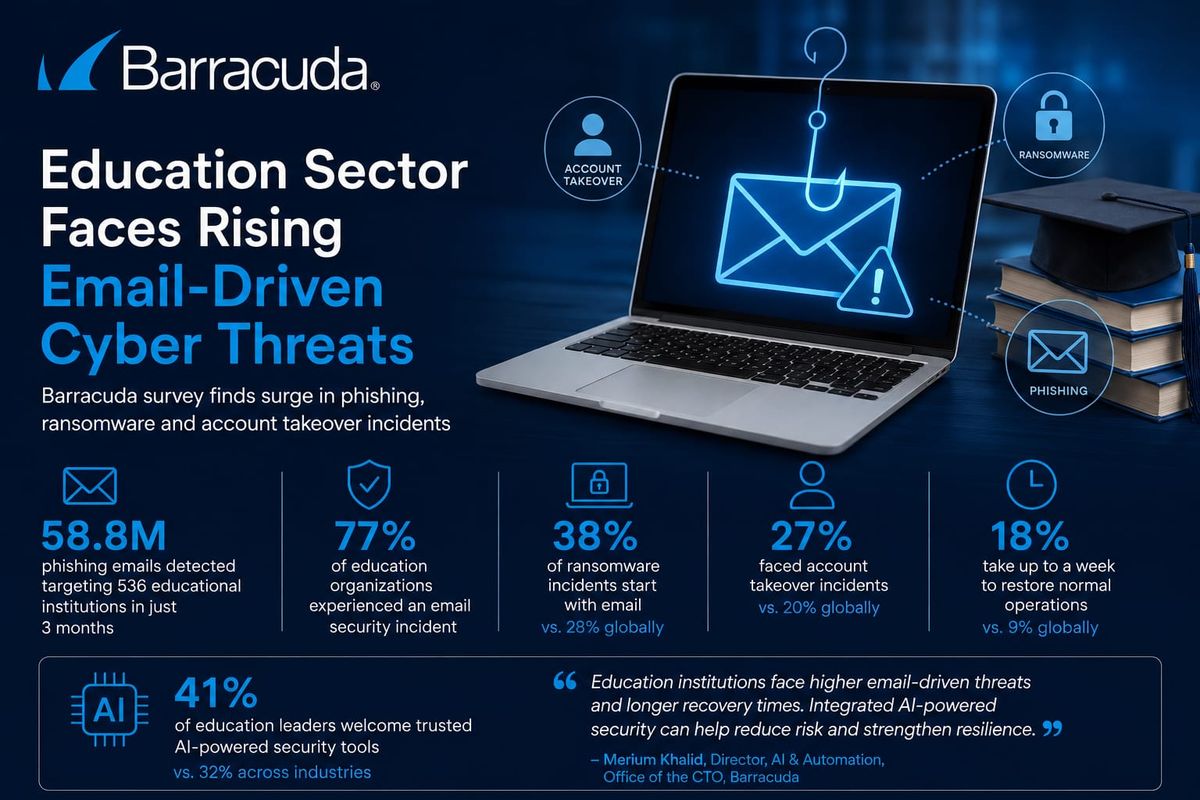
New Delhi, Sep 2 (INB) Educational institutions are facing heightened cyber risks, with email-driven ransomware and account takeover incidents emerging as major threats, according to a new international survey by cybersecurity firm Barracuda Networks.
Barracuda Research detected 58.8 million phishing emails targeting a sample of 536 educational institutions over a three-month period, equivalent to around 1,200 phishing emails hitting each institution every day, the company said on Wednesday.
The survey, which covered 2,000 IT and security leaders across the US, Europe and Asia Pacific, including 113 respondents from the education sector, found that 77 per cent of education respondents had experienced an email security incident in the past 12 months.
While 34 per cent said they had successfully detected and blocked phishing attacks, education organisations were four times more likely than the global average to say they could not determine whether they had experienced an email security incident, indicating that some attacks may have gone undetected.
The education sector also reported comparatively high rates of sophisticated email-borne attacks. Email was the starting point for ransomware incidents in 38 per cent of cases in education, against 28 per cent globally, while account-takeover incidents stood at 27 per cent compared with the global average of 20 per cent.
The survey highlighted delays in responding to cyber incidents. Only 58 per cent of education respondents said they could investigate suspicious email activity within one day, compared with 66 per cent globally. Similarly, 56 per cent said they could secure accounts and restore operations within a day, against 64 per cent overall.
Eighteen per cent of educational institutions took up to a week to restore normal operations, twice the global average of 9 per cent and the highest figure among all industries surveyed. User behaviour and human error were cited as leading contributors to incidents by 53 per cent of education respondents, compared with 48 per cent overall. Meanwhile, 36 per cent pointed to a lack of expertise in incident response and decision-making under pressure, while 33 per cent said responding quickly during live incidents was challenging.
The findings suggest that skills shortages and delays in investigation, containment and recovery can provide attackers with additional time to deepen access to compromised systems and increase the impact of incidents, Barracuda said.
Artificial intelligence is also emerging as a potential tool for strengthening cybersecurity. About 41 per cent of education respondents said they would welcome trusted AI-assisted detection and investigation tools, compared with 32 per cent across industries — the highest proportion among sectors surveyed. inb
“Education institutions face a compounded challenge. They experience higher rates of email-driven ransomware and account takeover incidents while also taking longer to investigate, contain and recover from attacks,” said Merium Khalid, Director, AI & Automation, Office of the CTO, Barracuda. Khalid said integrated AI-powered security could help reduce pressure on overstretched security teams, improve decision-making during incidents and accelerate response times. According to Barracuda, the findings underline the need for educational institutions to focus not only on preventing cyber threats but also on detecting, investigating, containing and recovering from incidents quickly.