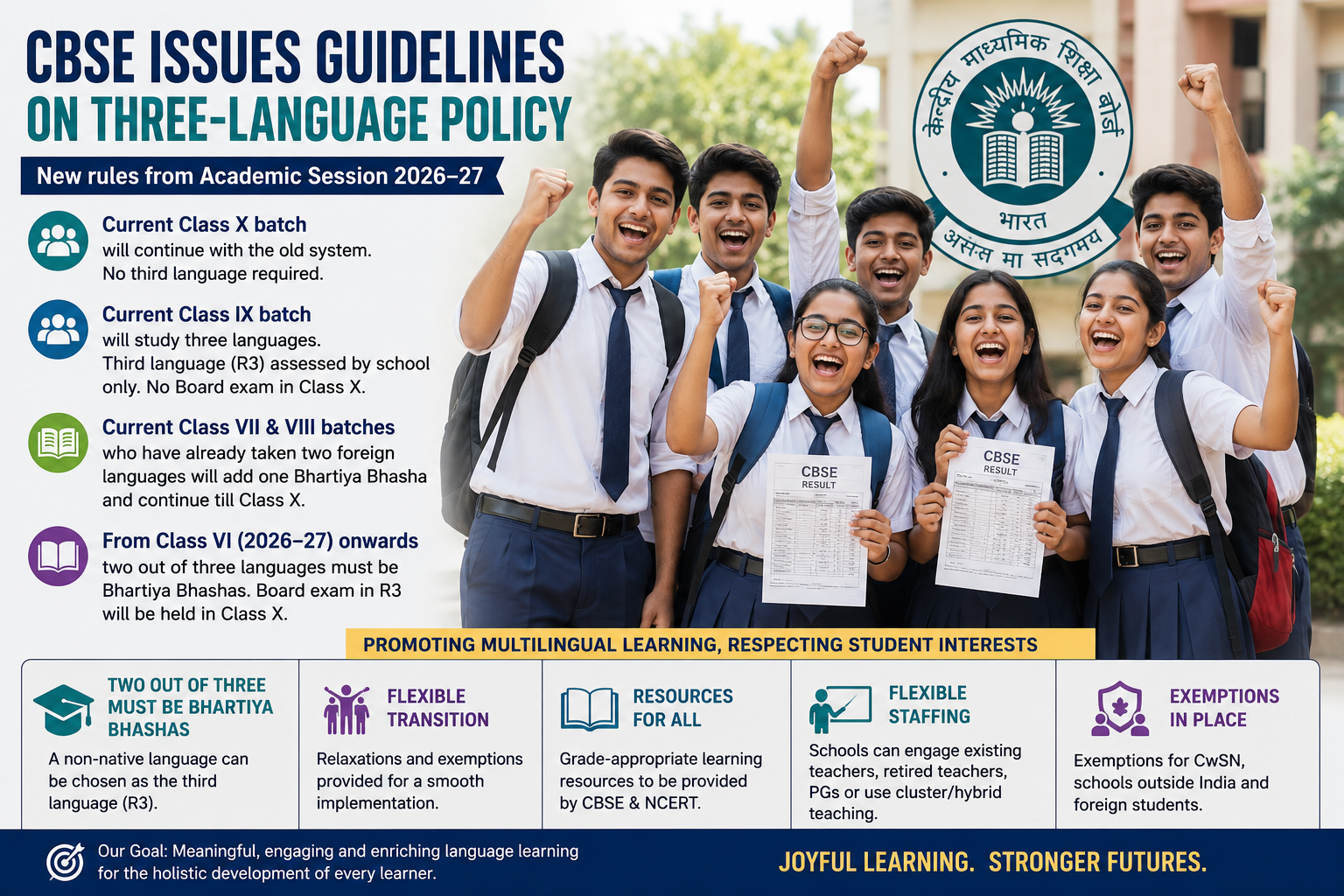
New Delhi, Jun 30 (INB) The Central Board of Secondary Education (CBSE) has issued detailed guidelines for implementing the three-language policy under the National Education Policy (NEP) 2020 in which it has exempted the current Class 10th batch from the new framework.
The Board has also provided a one-time relaxation for students currently studying in Classes VII, VIII and IX who had already opted for two foreign languages.
The guidelines, which will come into effect from the academic session 2026-27, aim to promote multilingual learning by requiring students to study three languages, with at least two being Bhartiya Bhashas (native Indian languages), while ensuring that no student is disadvantaged during the transition.
CBSE clarified that students currently studying in Class X during the 2026-27 academic session will continue with the existing two-language system and will not be required to study a third language.
Students in Class IX this academic year will study three languages, including at least two Bhartiya Bhashas. However, the third language will be assessed only through internal school-based evaluation, and there will be no CBSE Board examination for the subject when this batch appears for the Class X board examination in 2027-28.
Students currently studying in Classes VII, VIII and IX who had already opted for two foreign languages will be allowed to continue with their existing language combination by adding one Bhartiya Bhasha, without facing a Board examination in the third language at the secondary level.
For students entering Class VI in 2026-27 and subsequent batches, the three-language policy will be implemented in full. These students will study two Bhartiya Bhashas and will be required to appear for the Board examination in the third language when they reach Class X.
CBSE said dedicated textbooks for the third language in all 22 scheduled Indian languages are being made available by NCERT to support implementation.
The Board has exempted Children with Special Needs (CwSN), CBSE-affiliated schools located outside India and foreign students returning to India from the mandatory native Indian language requirement under the policy.
To facilitate implementation, CBSE has allowed schools to adopt flexible staffing arrangements, including engaging existing teachers, retired educators, postgraduate language experts, inter-school teacher sharing through Sahodaya clusters and virtual or hybrid teaching.
The Board said the guidelines have been framed to align with the objectives of NEP 2020 while safeguarding students’ interests. It emphasised that the focus will remain on joyful, meaningful and competency-based language learning rather than examinations, with additional learning resources and capacity-building support to be provided to schools.
Tags : CBSE, language rules, indian language promotion, foreign language course, NEP language , CBSE rules