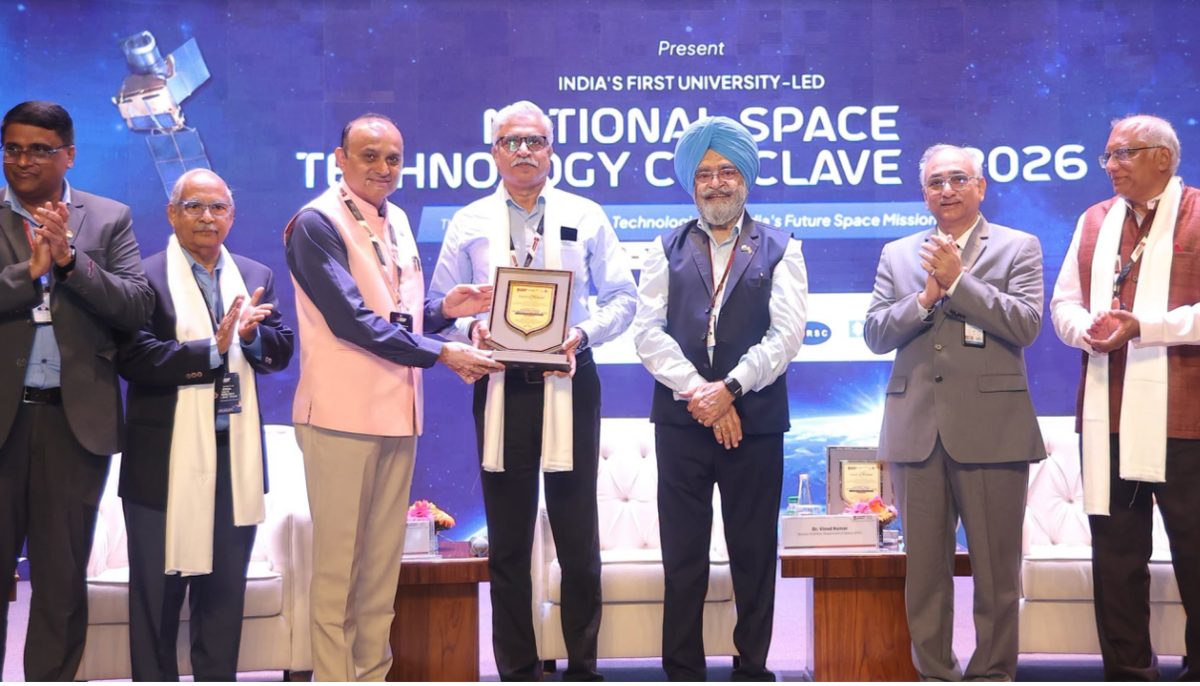
Chandigarh, Aug 20 (INB) Chandigarh University has become the first university to unveil a declaration on space technology for Viksit Bharat 2047, following deliberations at the National Space Technology Conclave 2026, according to an official statement. The two-day conclave, organised by the university’s Kalpana Chawla Centre for Research in Space Science and Technology (KCC) in collaboration with ISRO and the Indian Institute of Space Science and Technology (IIST), brought together space scientists, mission leaders, industry experts and academia, according to the statement issued on Monday, Around 30 scientists, mission leaders and technologists from ISRO, IIST, IN-SPACe, NewSpace India Ltd (NSIL) and UR Rao Satellite Centre (URSC), besides 10 CEOs and senior representatives from Indian space companies and start-ups, participated in the event, it stated. The university said the ‘Chandigarh University Declaration on Space Technology for Viksit Bharat 2047’ seeks to provide strategic direction for the role of universities in advancing India’s space ambitions, with a focus on education, research, innovation, skill development and industry collaboration. Dr Vinod Kumar, Director, Promotion Directorate, IN-SPACe, said India’s space sector has witnessed significant growth since the opening of the sector to private participation in 2020. He highlighted the emergence of more than 450 space start-ups and said initiatives such as the Space Seed Fund, Technology Adoption Fund, venture capital fund and pre-incubation programmes are aimed at supporting young innovators. Former ISRO Scientific Secretary Dr YVN Krishnamurthy said India’s space programme must focus not only on satellite launches but also on developing cost-effective technologies and solutions for societal benefit. He encouraged students to move beyond conventional learning and develop innovative solutions, noting that India would require a strong talent pool for future space capabilities. Nilesh M Desai, former Director of the Space Applications Centre (SAC), ISRO, said the initiative could help promote space activities among students and contribute to developing skilled professionals for India’s growing space sector, particularly in communication and navigation. Sanjay, CEO of Dhruva Space, said India has significant potential to expand its private space ecosystem and move from meeting domestic requirements to serving global markets. He also called for greater focus on small-satellite constellations that could support India’s social and strategic objectives. Prof (Dr) Eswar Sunkara, Senior Director, Kalpana Chawla Centre, Chandigarh University, said the declaration would provide a roadmap for universities to contribute more meaningfully to national space missions. He said the university aims to establish itself as a regional hub for space research, technology and innovation and develop space-ready human resources with the support of national space institutions. The first day of the conclave featured expert discussions, roundtables, technology demonstrations and interactions between students and space scientists, astronauts and industry representatives, focusing on technologies and capabilities required for India’s future space missions.